
Stepping into the academic world as an unpaid carer
Emma Williams, Sue Williams and Annie Jones are DeNPRU-QM’s Public Advisor Researchers. They all have personal experience of caring for a family member with dementia and/or a neurodegenerative disease. They are employed one day a week as researchers at the University of Liverpool, a role where they actively work on projects and develop their research skills. A few months on from presenting at their first academic conference, they share their reflections on this experience.

Our journey started when we were asked if we would like to talk at the 6th Annual Liverpool Dementia and Ageing Conference about our experiences of becoming a Public Advisor Researcher. We were all so excited to be asked and were full of enthusiasm, so it was a resounding “yes, that’d be great”. Or would it?
Emma – Arriving at the conference and being handed a name badge with ‘Academic’ after my name was the first highlight. We were on quite soon after lunch, and it wasn’t until I’d finished my 2nd, or maybe 3rd dessert that the nerves hit! Who’s going to be interested in my story? As a former school teacher, speaking in front of people was my thing. Give me a room full of teenagers any day! But now, in a room full of academics, I suddenly felt like I did before my first ever teaching class. But then, with a huge picture of Mam on the screen, off I went!
Sue – On the day, there are a lot of smart people in the room, topics and themes cover many perspectives, and the academic and medical language can be confusing. Then it is time to stand and deliver. There are some nerves. Will I sound like the rookie I feel? Then we’re up, sharing our first year, explaining why and how we got here, the sadness and frustrations, the losses and the idea that now, all of this has value. I’ve really come to understand that adding the lived experience to the skill and knowledge of the academics creates a fuller and more rounded perspective.
Annie – Before the conference I felt quite nervous. We had just 10 minutes to fit in a lot of important information. We knew that we had to make every word count, and so put a lot of energy into ensuring that we achieved this. On the day, we were so well rehearsed that I was surprised to find that I hardly felt nervous at all! It was a brilliant experience to be part of our little team, feeling valued by the wider team, and knowing that our contribution to the bigger picture of research is making a difference to people with dementia.
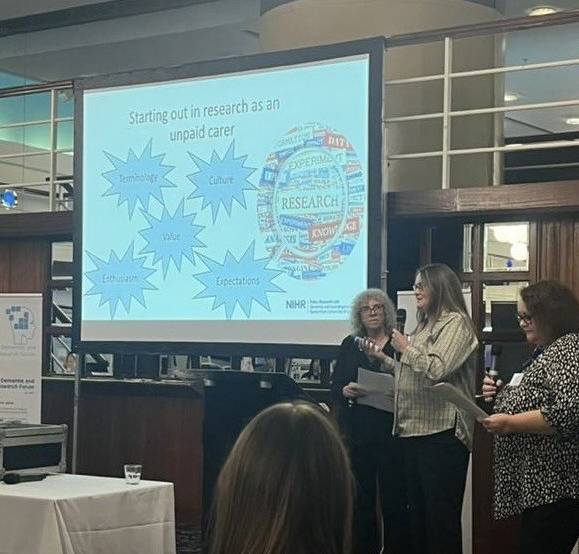
And then suddenly it was all over. Had we done ok? Well the feedback was amazing and it turns out that people really were interested in our stories. We did good! Would we do it again? Oh yes…